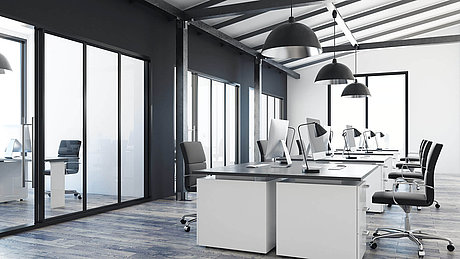
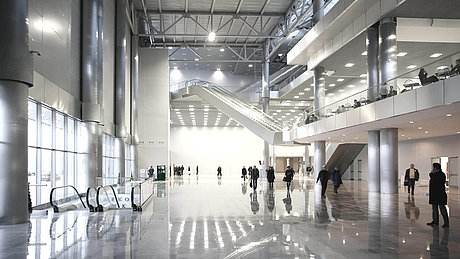

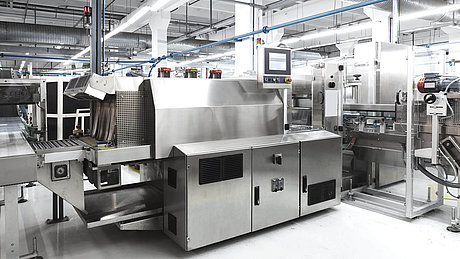

Prediction of sound inside rooms

CadnaR Overview
CadnaR is the powerful software tool for the calculation and assessment of sound inside rooms and at workplaces. With its various features and software configurations, CadnaR covers the widest range of indoor acoustic applications from specific planning of noise level reduction measures in production plants to the optimization of rooms under consideration of psychoacoustic parameters.
CadnaR is a clearly arranged software enabling the user to easily build models and make precise predictions. When the project becomes more complex you will benefit from the sophisticated input possibilities.
CadnaR uses scientific and highly efficient calculation methods. Many acceleration procedures, such as the use of the CUDA cores of your graphics card, enable a fast calculation process.
Use modern techniques like scenario comparisons or display of results in 3D to enhance your analysis during the whole assessment process.
CadnaR includes a multi-lingual user interface. The functionalities and the handling of CadnaR are nearly identical to CadnaA, enabling an efficient workflow in both fields of expertise.
Get to know CadnaR in our free Demo Tutorial – in your browser, no registration required. If you prefer, test the software directly with a demo download. Complete the tutorial and work with the full version, including all options, for one month. Offer valid until 31 December 2026.
Start the tutorialRequest your free monthCadnaR configurations
Explore CadnaR and its related options designed to cover specific applications and available for one-time purchase or subscription.
CadnaR offers flexible licensing options, either on-premises (via local or server USB dongle) or through cloud licensing.
Optional software updates and hotline support are available.*
*For cloud licensing, a maintenance contract is required."
Available for one-time purchase or subscription.
Frequently Asked Questions about CadnaR
The questions prospective users ask most about CadnaR — answered right here.
See also: View all questions · Download the demo version
You will find all learning and knowledge material in the Resources section on datakustik.com: web tutorials, trainings, congress papers and publications, Technical Notes and the e-learning Center, which offers online courses for registered users with active software maintenance.
CadnaA calculates outdoor/environmental noise (road, rail, industry, aircraft and city noise mapping). CadnaB handles building acoustics (airborne and impact sound insulation for whole buildings). CadnaR predicts room and indoor acoustics such as reverberation time and speech intelligibility. Together they form one integrated platform.
Typical applications fall into two areas. First, room-acoustic design for offices, schools, day-care centres, restaurants and sports halls, including verification of reverberation time and speech intelligibility under DIN 18041. Second, industrial acoustics: from determining noise exposure and noise dose at workstations (dosimeter function) through modelling complex machines — including calibration and verification of sound power levels to ISO 3744 and the emission sound pressure level at the machine operator position to ISO 11204 — to the full assessment and improvement of an industrial hall, with side-by-side comparison of noise control measures in planning variants, the design of PA/PAGA systems, and auralisation of the results: audible before anything is built.
DataKustik offers classroom seminars (Expert seminars) and web seminars, and the free web tutorials for CadnaR. The CadnaR Demo Tutorial in the e-learning Center is open to everyone — no software maintenance required. Current dates: datakustik.com/resources/trainings.
Yes. DataKustik offers free demo versions of CadnaA, CadnaB and CadnaR that let you test noise prediction and acoustics simulation on your own projects. Download the demo version at datakustik.com/demo.
Yes. CadnaR predicts sound levels in work rooms, offices and production halls, so workplace noise (for example under national workplace regulations such as ASR A3.7 in Germany) can be evaluated and mitigation measures compared at the planning stage.